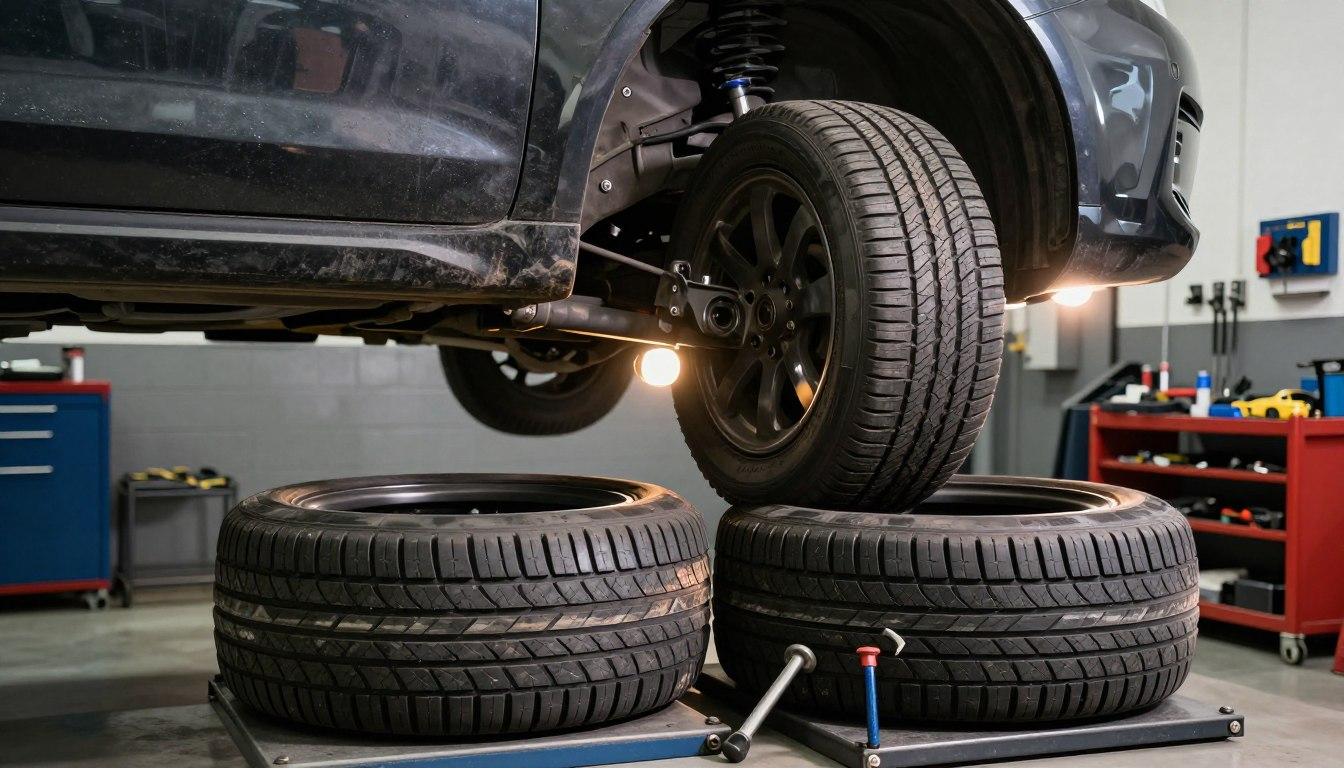
Last reviewed: 02, March 2026
Editorial note: This guide is for general information only and is not a substitute for your owner’s manual or professional service advice.
Scope: This article is for front-wheel-drive passenger vehicles with four road tires of the same size, unless your owner’s manual says otherwise. That matters because rotation advice changes when you have directional tires, staggered sizes, a performance fitment, or a manufacturer-specific rule. Michelin, Goodyear, and NHTSA all make the same basic point: rotation pattern depends on the vehicle and tire setup, and the owner’s manual should win if it gives a specific instruction. (Michelin)
For most front-wheel-drive cars with non-directional, same-size tires, the standard answer is the forward cross pattern: the front tires move straight back, and the rear tires cross to the front. Michelin describes this as a common front-wheel-drive rotation pattern because FWD vehicles place more wear on the front tires. (Michelin)
The short version
If your car has four same-size, non-directional tires, the usual FWD pattern is:
- Front left → rear left
- Front right → rear right
- Rear left → front right
- Rear right → front left
That is the cleanest default answer for most ordinary FWD cars, but it is not universal. Michelin, Goodyear, and NHTSA all say the pattern must match the tire type and the vehicle setup. (Michelin)
Why FWD cars need rotation sooner than some drivers expect
Front-wheel-drive vehicles ask more of the front tires. They handle steering, much of the braking load, and the engine’s drive load, so they usually wear faster and in different patterns than the rear tires. Michelin’s tire-care guidance says regular rotation helps ensure more even wear, extends tire life, and helps maintain performance. Bridgestone also says regular rotation gives you a chance to inspect the tires for damage, air pressure issues, tread depth, and balance-related problems. (Michelin)
That is the real reason to rotate: not because it is a ritual, but because it keeps one axle from wearing out much faster than the other and helps you catch alignment or suspension issues sooner. NHTSA also says uneven tread wear can indicate the need for rotation and/or alignment. (NHTSA)
When the forward-cross pattern is the right choice
Use the forward cross pattern when all of these are true:
- the car is front-wheel drive
- all four tires are the same size
- the tires are non-directional
- the owner’s manual does not call for something different
That is the setup Michelin describes in its FWD tire-rotation guidance. (Michelin)
When you should not use forward cross
The biggest weakness in the original draft was that it treated forward cross like a universal rule. It is not.
If the car has directional tires, Goodyear says they should normally be rotated front to back on the same side only unless the tires are removed from the wheels and remounted. Michelin says the same thing: directional tires must follow the sidewall arrows, and if all four are the same size, they are generally rotated front to back. (Goodyear)
If the car has different tire sizes front and rear, Goodyear says those tires usually cannot be rotated axle to axle. In that case, rotation may be limited to side to side, and only if the tires are non-directional and the wheel/tire setup allows it. (Goodyear)
If the vehicle has a full-size spare and the manual specifies a five-tire rotation, follow the manual rather than a generic online chart. NHTSA’s older tire-safety brochure also says to look in the owner’s manual for the correct pattern and interval. (NHTSA)
How often to rotate
A practical general interval is about 5,000 to 8,000 miles, but the best answer is still: follow your owner’s manual and tire maker guidance. Bridgestone says many drivers rotate around 5,000 miles, and Goodyear says 6,000 to 8,000 miles is a common interval to help equalize tread wear. (Bridgestone Tires)
Rotate sooner if you notice obvious front-to-rear tread differences or irregular wear. NHTSA says uneven wear across the tread can indicate the need for rotation and/or alignment. (NHTSA)
A safer DIY process
If you are rotating tires at home, the biggest trust issue is safety. The cleaner, more defensible version of the DIY advice is:
- work on a flat, solid surface
- use wheel chocks
- loosen lug nuts slightly before lifting
- lift the vehicle only at the correct jacking points
- support it with jack stands
- install the wheels in the correct pattern
- hand-thread lug nuts first
- snug them in a star pattern
- lower the car and torque lug nuts to specification
- set tire pressures to the door-jamb placard
- reset or relearn TPMS if required by the vehicle
The single most important correction in your original draft is this: never tell readers to tighten lug nuts “as tight as possible.” Lug nuts should be tightened to the manufacturer’s torque specification. Over-tightening can damage studs, wheels, or brake components. (Bridgestone Tires)
Rotation will not fix underlying wear problems
A strong maintenance article should say this clearly: tire rotation helps manage wear, but it does not fix the cause of irregular wear.
If you see:
- inside-edge wear, suspect alignment
- cupping or scalloping, suspect suspension or balance issues
- both shoulders worn, suspect underinflation
- center wear, suspect overinflation
NHTSA says uneven tread wear can indicate rotation and/or alignment needs, and Michelin likewise notes that rotation is also a good time to inspect for other tire or suspension problems. (NHTSA)
That means a rotation guide should always tell readers when to stop and inspect further rather than simply moving the tires around and hoping the problem disappears.
Conclusion
For most ordinary front-wheel-drive cars with four same-size, non-directional tires, the correct default pattern is forward cross: the front tires go straight back, and the rear tires cross to the front. Michelin’s guidance supports that pattern directly. (Michelin)
But the real answer is slightly more careful than that: check the tire type, check whether the setup is staggered, and follow the owner’s manual if it gives a specific pattern or interval. Directional tires usually stay on the same side, and staggered setups often cannot be rotated front to rear. (Goodyear)
The best tire-rotation article is not the one with the most diagrams. It is the one that helps readers avoid doing the right pattern on the wrong setup.