Last reviewed: 10 January, 2026
Editorial note: This guide is for general information only and is not a substitute for your owner’s manual, local laws, or professional service advice.
Scope: This guide is written mainly for U.S. family road trips in ordinary passenger cars, crossovers, and SUVs during warm-weather travel. Exact legal and vehicle requirements vary, so your owner’s manual, tire placard, insurance documents, and local rules still take priority over any general checklist. NHTSA and AAA both recommend checking core safety items such as tires, cooling system, battery, lights, wipers, and fluid levels before a long summer drive. (NHTSA)
A better version of a summer road-trip article is not a giant list of random gear. It is a practical guide built around the problems most likely to ruin a trip: heat, dehydration, dead phones, flat tires, weak batteries, poor visibility, and food or medication packed badly. NHTSA’s road-trip prep guidance, CDC travel heat advice, and weather-service heat safety guidance all point toward that same reality. (NHTSA)
Start with the car, not the suitcase
Before you pack anything fun, make sure the vehicle itself is ready. NHTSA says to inspect your tires before long road trips, including the spare, and to check cooling system, fluid levels, battery, lights, and wiper blades before summer travel. AAA’s summer travel checklist recommends many of the same items. (NHTSA)
A strong pre-trip check should include:
- cold tire pressure, including the spare, using the door-jamb sticker pressure, not the maximum number on the sidewall
- a quick look for nails, screws, sidewall bulges, exposed cords, cracks, or uneven wear
- engine oil level
- coolant level, but only when the engine is cool
- washer fluid and wiper condition
- lights, including brake lights and turn signals
- battery condition, especially if the car has been slow to crank
- a short test drive to confirm the brakes, steering, temperature, and warning lights all feel normal
NHTSA says underinflation is a leading cause of tire failure, tread should be at least 2/32 inch, and uneven wear is a sign to pay attention. AAA also advises checking brakes, securing the battery, and topping off fluids before summer travel. (NHTSA)
This is a good place to add internal links on your site to your tire pressure guide, battery warning guide, and road trip car checklist article.
The documents and tech you actually need
For a U.S. road trip, the practical basics are:
- driver’s license
- current registration
- proof of insurance
- roadside assistance details
- emergency contacts
- phone charger and backup charging cable
- power bank
- offline maps or downloaded route backups
AAA and insurer guidance consistently recommend keeping key driving documents accessible and making sure your roadside-assistance details are easy to find before travel. A power bank, charger, and offline maps are not legal requirements, but they are among the highest-value items you can carry because they help when the phone battery is low or signal is weak. (AAA)
A stronger version of the draft also needs one privacy fix: keep only the necessary vehicle documents in the car, and keep digital backups stored securely on your phone or cloud account. That is more practical than carrying oversized folders of personal paperwork.
Pack for heat first, comfort second
Summer road trips are different from spring or fall because heat changes what matters. CDC travel guidance says to drink plenty of non-alcoholic fluids, wear sunscreen, hat and sunglasses, and use loose, lightweight clothing in hot conditions. CDC’s summer-travel pages also say sun protection matters even when people are not headed to a beach. (CDC)
That makes the real summer essentials:
- water for every person in the car
- a little extra water if the route is remote or very hot
- broad-spectrum sunscreen
- sunglasses
- a hat or cap
- lightweight clothing and one light extra layer
- personal medications packed somewhere reachable, not buried in luggage
If you want a shorter rule, it is this: hydration, shade, and power matter more than packing three extra outfits.
Food, coolers, and low-mess storage
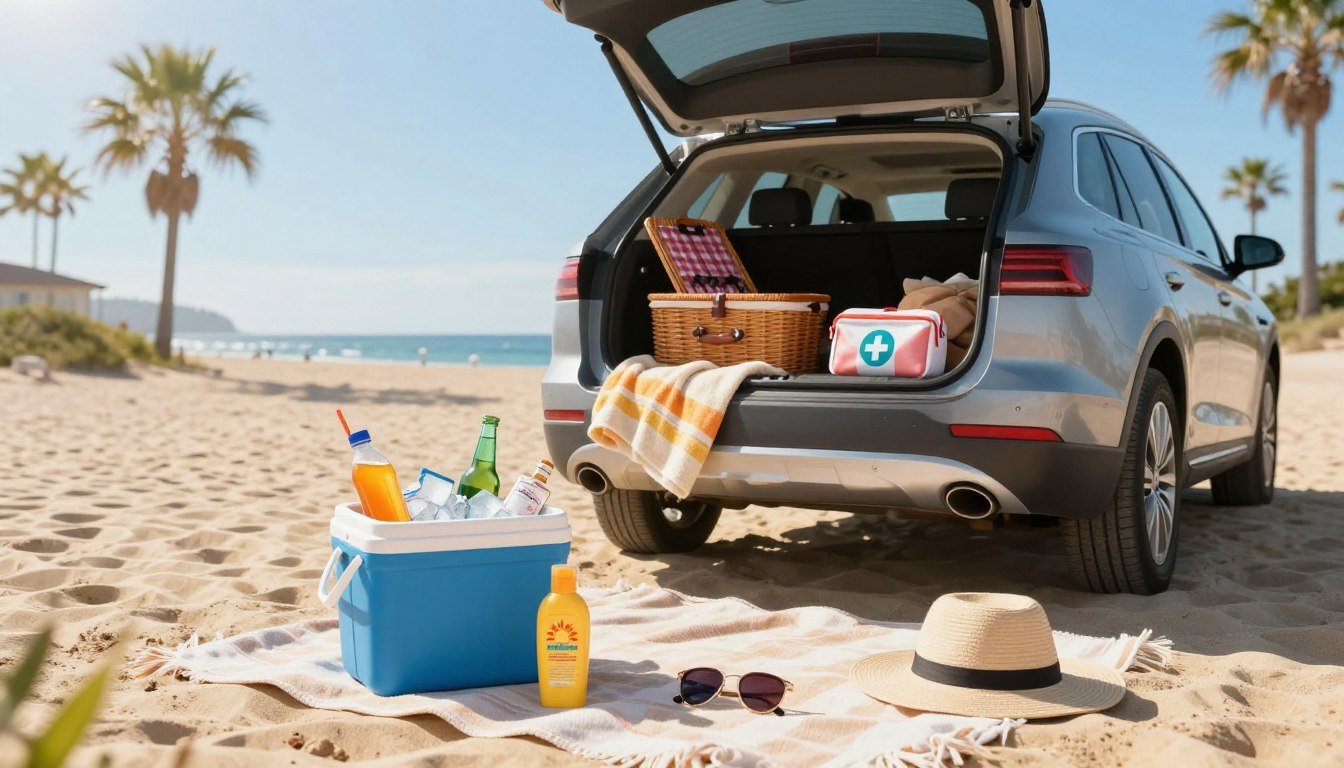
The original draft was directionally right here, but it needed less filler. In hot weather, the practical goal is to keep food simple, cold if necessary, and easy to reach without unloading the whole trunk. A small cooler or insulated bag, ice packs, reusable bottles, easy snacks, wipes, and a few trash bags usually matter more than elaborate food prep. CDC’s heat-travel guidance supports prioritizing hydration, and the rest is mostly about convenience and cleanliness. (CDC)
A useful setup is:
- one cooler or insulated bag for drinks and perishable items
- reusable water bottle for each person
- shelf-stable snacks such as nuts, crackers, bars, or dried fruit
- wipes, napkins, and a few small trash bags
That keeps the car cleaner and reduces the “we packed a lot but can’t find anything” problem.
The small safety kit that covers the most common problems
A good summer road-trip kit does not need to be huge. It just needs to cover the most common roadside delays.
A practical minimum kit:
- jump pack or jumper cables
- flashlight or headlamp
- reflective triangle or other legal roadside warning device
- basic first aid kit
- bottled water
- work gloves
- tire pressure gauge
- small air inflator if you have room
NHTSA’s pre-trip guidance and roadside-safety messaging both support checking the spare and being ready for basic roadside issues rather than improvising after something goes wrong. (NHTSA)
A compact blanket also earns its place because it helps with cold A/C, roadside waiting, and unexpected overnight delays.
One summer warning that should stay in the article
This part should stay, because it matters: never leave children or pets in a parked car, even briefly. The National Weather Service says it is never safe to leave a child, disabled person, or pet locked in a car, even outside summer, and warns that vehicle temperatures can become deadly very quickly. (National Weather Service)
That warning is stronger and more trustworthy when it comes from an official heat-safety source instead of a generic blog-style reminder.
A simpler packing structure that works better
To reduce clutter and make the article feel less templated, group the packing into four real categories:
1. Must-have documents and tech
License, registration, insurance, roadside assistance, charger, power bank, offline maps. (AAA)
2. Heat and hydration essentials
Water, sunscreen, sunglasses, hat, light clothing, medications. (CDC)
3. Safety kit
Jump-start option, flashlight, reflective triangle, first aid, gloves, tire gauge. (NHTSA)
4. Comfort and cleanup
Cooler, snacks, wipes, hand sanitizer, tissues, small trash bags, light blanket. (CDC)
That is enough structure for readers without turning the page into a scaled checklist template.
Bottom line
A strong summer road trip is usually built on small, boring decisions made before you leave: check the tires, check the fluids, confirm the battery and lights, carry enough water, protect against heat and sun, and keep the right safety gear reachable. NHTSA, AAA, CDC, and the National Weather Service all support that same practical approach. (NHTSA)
The best version of this page is not “everything you could possibly bring.” It is a focused guide that helps readers avoid the handful of mistakes that actually ruin summer drives.
Internal links to add on your site
To strengthen the page and make it feel less like a standalone SEO post, add 2–4 real internal links inside the article to your own:
- road trip car checklist
- optimal tire pressure guide
- what to keep in your glovebox
- after a car accident checklist
- dashboard warning lights guide
References
- NHTSA, Summer Driving & Road Trip Tips — tires, cooling system, fluid levels, battery, lights, and wipers. (NHTSA)
- NHTSA, Summer Driving Tips PDF — inspect tires before long trips, check the spare, underinflation as a leading cause of tire failure, tread guidance. (NHTSA)
- AAA Automotive, Prepare Your Car for Summer Travel — tires, brakes, battery, and fluids. (AAA)
- AAA, Summer Road Trip Car Prep Checklist PDF. (AAA)
- AAA Via, Is Your Car Ready for a Road Trip? — coolant, fluids, and trip prep. (AAA)
- CDC Travelers’ Health, Heat Illnesses — fluids, sunscreen, hat, sunglasses, light clothing. (CDC)
- CDC Travelers’ Health, Summer Travel and Sun Exposure — sunscreen and sun protection guidance. (CDC)
- National Weather Service, Children, Pets and Vehicles and general heat-safety guidance. (National Weather Service)
A few final publishing fixes still matter:
- Replace “Gustavoblalmiras” with a real byline and real expertise.
- Remove the YouTube embed unless it adds real value.
- Remove stock-style images if they do not add useful information.
- Keep the title practical, like “Summer Road Trip Packing Guide: What to Bring and What to Check Before You Leave”, instead of a more generic search-batch title.