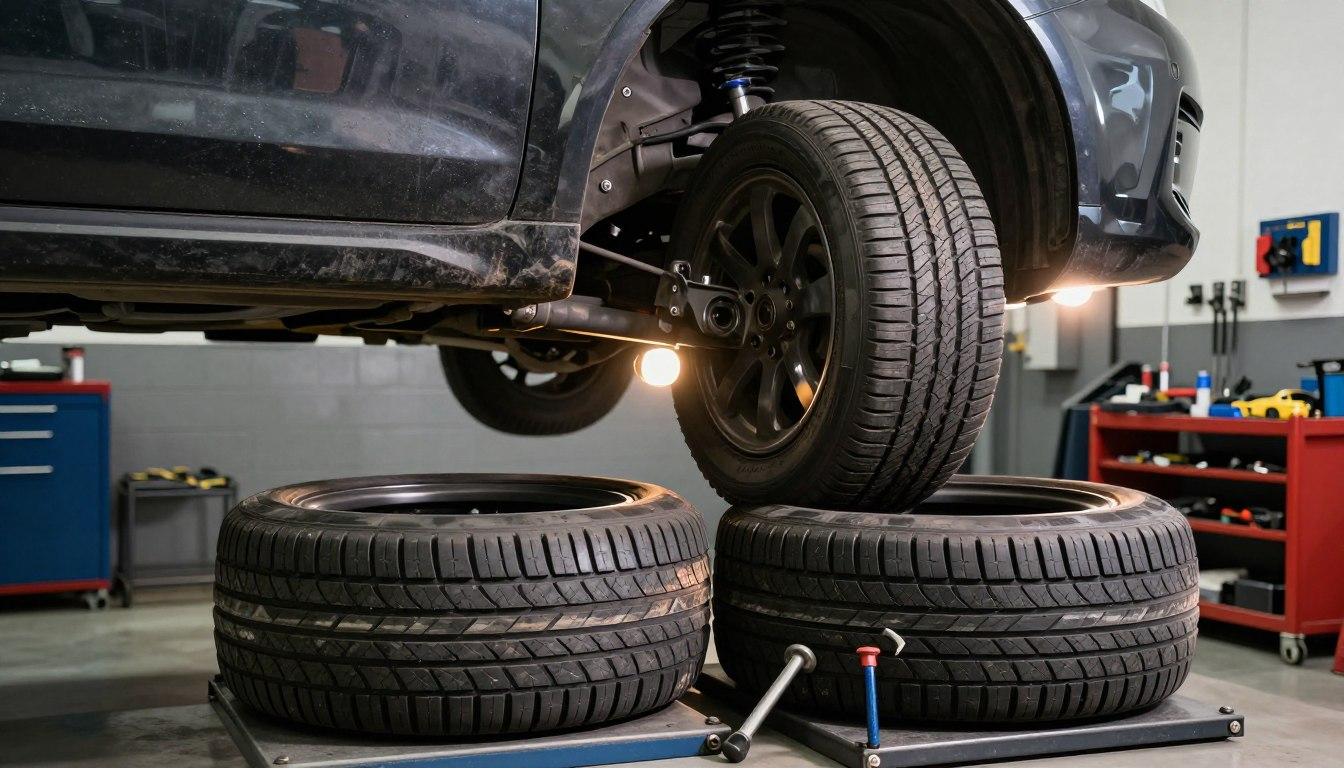
By Gustavoblalmiras
Tire rotation is one of the simplest ways to make your tires last longer, improve traction, and keep your front-wheel-drive (FWD) car feeling predictable—especially in rain and braking. Because FWD cars put the biggest workload on the front tires (steering + braking + acceleration), the fronts usually wear faster and in different patterns than the rears.
This is only for educational purposes.
In this guide you’ll learn the recommended tire rotation pattern for front-wheel drive, how to choose the right pattern for directional or staggered setups, and a safe step-by-step process you can do at home with basic tools.
Quick answer (the pattern most FWD cars use)
Most FWD vehicles with non-directional, same-size tires use the “Forward Cross” pattern:
- Front tires go straight back (FL → RL, FR → RR)
- Rear tires cross to the front (RL → FR, RR → FL)
Always confirm your owner’s manual first. Some vehicles (especially performance cars, some AWD systems, and certain tire types) have specific rules.
Why Rotating Your Tires Is Essential on Front-Wheel Drive
FWD cars naturally wear the front tires faster because the front axle is doing most of the work. Even if your alignment is perfect, the front tread sees more “scrub” from turning, plus more load under braking and acceleration.
What rotation actually does (simple explanation)
- Balances wear: moves tires through different positions so one pair doesn’t get “used up” early.
- Helps traction stay consistent: especially important for wet braking and emergency maneuvers.
- Extends tire life: you’re less likely to replace two tires early while the other two still look “fine.”
- Can reveal problems early: odd wear patterns can point to alignment, suspension, or inflation issues.
Understanding FWD Tire Wear vs RWD and AWD

FWD: front tires usually wear faster. Rotation patterns typically move rear tires to the front to “share” the harder work.
RWD: rear tires often wear faster because they handle acceleration load (and sometimes more weight transfer).
AWD: wear can be more even, but many AWD systems are picky about tire diameter differences—so consistent rotation matters even more to protect the drivetrain.
Recommended Tire Rotation Patterns for Front-Wheel Drive
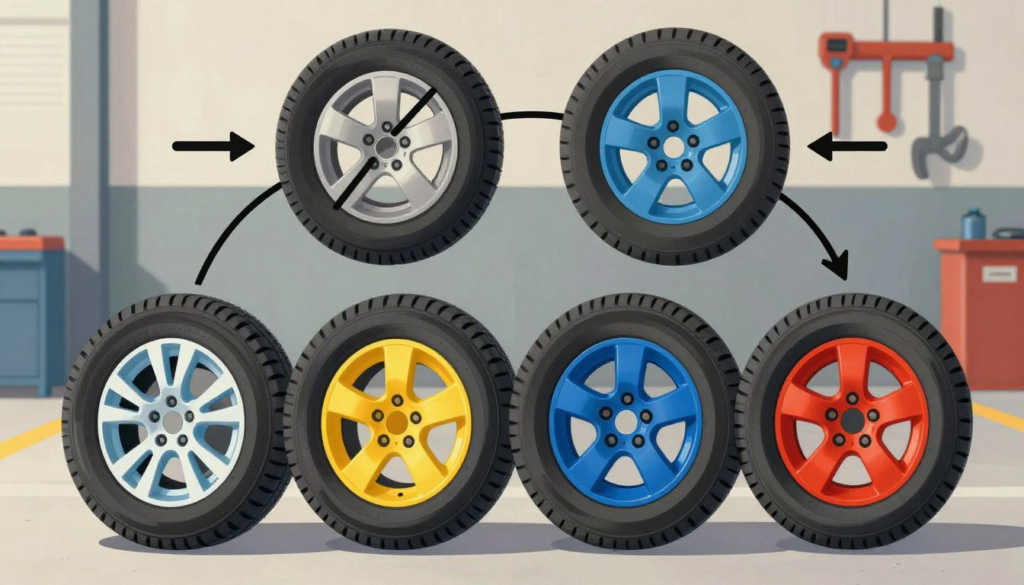
Choose your pattern based on your tire type (directional vs non-directional), whether all four tires are the same size, and any rules in your owner’s manual.
Pattern cheat sheet (use this table)
| Your setup | Best pattern | How it moves |
|---|---|---|
| FWD + non-directional + same size | Forward Cross (most common) | Fronts straight back; rears cross to front |
| Directional tires (arrow on sidewall) | Front-to-Rear (same side) | FL → RL, FR → RR (no crossing unless remounted) |
| Staggered sizes (front ≠ rear) | Side-to-side only (if allowed) | Swap left/right only if tires are non-directional and wheels match |
| Full-size spare included | Manual-specific | Some cars use a 5-tire rotation; follow manual |
1) Forward Cross (recommended for most FWD cars)
If your tires are non-directional and all four are the same size, Forward Cross is usually the best default:
- Front Left → Rear Left
- Front Right → Rear Right
- Rear Left → Front Right
- Rear Right → Front Left
This pattern puts the less-worn rear tires up front where FWD needs the most traction for braking and steering.
2) Directional tires (arrow on sidewall): don’t cross them
Directional tires are designed to roll one way. You’ll see an arrow on the sidewall showing the correct rotation direction.
Rotation rule: keep them on the same side of the car:
- Front Left ↔ Rear Left
- Front Right ↔ Rear Right
If you want to “cross” directional tires, it usually requires dis-mounting and re-mounting on the wheels (a tire shop job). For most drivers, front-to-rear rotation is the correct approach.
3) Staggered tires (different sizes front and rear)
If your car uses different tire sizes front vs rear, you often cannot rotate front-to-rear. In some cases you can rotate left-to-right (only if the tires are non-directional and the wheel/tire setup allows it). When in doubt: follow the owner’s manual or ask a tire shop.
How Often Should You Rotate Tires on a FWD Car?
Many vehicles fall in the 5,000–8,000 mile (8,000–13,000 km) range, often aligning with oil change intervals. But the best answer is always: follow your owner’s manual and your tire maker’s guidance.
Rotate sooner if you notice:
- front tread wearing much faster than rear
- new vibrations after tire replacement or balancing
- uneven wear (feathering, cupping, inside-edge wear)
Tools and Equipment You’ll Need (Safe DIY Setup)
Rotating tires is straightforward, but it must be done safely. If you don’t have the right equipment, it’s better to pay a shop than risk injury.
Essential tools
- Wheel chocks (or sturdy blocks) to prevent rolling
Helpful extras
-
- tire pressure gauge (check PSI after rotation)
-
- gloves + a kneeling pad
-
- chalk/marker or tape (label tires FL/FR/RL/RR)
Preparation Steps Before You Rotate
1) Choose a safe work area
Work on a flat, solid surface (level driveway or garage). Avoid gravel or sloped areas. Put the car in Park (or in gear for manuals) and set the parking brake.
2) Inspect tires before rotating (this is where you catch problems)
Check each tire for:
-
- bulges, cracks, nails/screws
-
- uneven wear (inside edge, outside edge, cupping)
-
- tread depth differences front vs rear
If you see cords, a bubble, or serious cracking—stop and replace the tire. Rotation won’t fix a structurally unsafe tire.
3) Slightly loosen lug nuts before lifting
Crack each lug nut loose while the car is still on the ground (about 1/4 turn). Don’t remove them yet. This prevents the wheel from spinning while you try to loosen tight nuts in the air.
Step-by-Step Tire Rotation Process (FWD Forward Cross)
This process assumes non-directional, same-size tires on a front-wheel-drive vehicle. If you have directional or staggered tires, use the correct pattern above.
-
- Chock the wheels (place chocks behind at least one rear wheel if lifting the front first).
-
- Lift the vehicle at the correct jacking points (check your owner’s manual) and set it securely on jack stands.
-
- Remove wheels and place them flat on the ground near their new positions.
-
- Move tires into the Forward Cross pattern:
FL → RL, FR → RR, RL → FR, RR → FL.
- Move tires into the Forward Cross pattern:
-
- Hand-thread lug nuts first to avoid cross-threading.
-
- Snug lug nuts in a star pattern while the car is still on stands (do not fully torque yet).
-
- Lower the car so the tires contact the ground.
-
- Torque lug nuts to spec using a torque wrench (star pattern). The correct torque is in your manual or service info.
-
- Set tire pressures to the door-jamb placard PSI (front and rear may differ).
-
- Reset/learn TPMS if required (some cars auto-learn; others need a menu reset or tool).
Important safety correction: Do not tighten lug nuts “as tight as possible.” Over-tightening can stretch studs, warp brake rotors, or make roadside removal impossible. Always torque to the correct specification.
After Rotation: Quick Verification (2-minute test)

-
- Start the car and verify no new warning lights.
-
- Drive slowly at first and listen for unusual noises.
-
- Check steering feel and braking feel in a safe area.
-
- If your manual recommends it, re-check lug nut torque after a short drive.
Troubleshooting Common Tire Rotation Problems
Stuck lug nuts
If lug nuts won’t budge, use safer leverage—not unsafe force.
-
- Use a longer breaker bar for leverage (controlled pressure).
-
- Avoid jumping on the wrench (risk of injury and damage).
-
- If a lug nut rounds off or a stud looks damaged, stop and get help.
Uneven wear patterns that rotation won’t fix
Rotation helps wear even out, but it doesn’t correct underlying mechanical issues. Common “messages” your tires send:
| Wear pattern | Often suggests | What to do |
|---|---|---|
| Inside-edge wear | alignment/camber issue | Get alignment checked |
| Cupping/scalloping | shock/strut or balance problem | Inspect suspension, balance tires |
| Both edges worn | underinflation | Correct PSI, check for leaks |
| Center worn | overinflation | Return to door-placard PSI |
When to pay a professional
-
- You don’t have jack stands or a torque wrench
-
- You see cords/bulges/cracks or severe uneven wear
-
- Car has complex sensors/TPMS learning requirements you can’t reset
-
- You suspect alignment or suspension issues
Conclusion
For most front-wheel-drive cars, the best routine is simple: rotate tires on schedule using the Forward Cross pattern (when tires are non-directional and same-size), keep pressures at the door-placard PSI, and watch for unusual wear that signals alignment or suspension problems.
Done consistently, tire rotation improves traction consistency, helps tires last longer, and reduces the “fronts wear out early” problem that FWD owners know too well.
FAQ
What is the recommended tire rotation pattern for front-wheel drive vehicles?
Most FWD cars with non-directional, same-size tires use the Forward Cross pattern: fronts go straight back, rears cross to the front.
How often should I rotate tires on a front-wheel drive car?
Common guidance is around 5,000–8,000 miles, but the correct interval is whatever your owner’s manual (and tire manufacturer) specifies.
Can I rotate directional tires using the forward cross pattern?
No. Directional tires must stay rotating in the correct direction, so you typically rotate front-to-rear on the same side (no crossing unless a shop remounts them).
Do I need to torque lug nuts, or is “tight enough” okay?
You should torque lug nuts to the manufacturer’s specification. Over-tightening or under-tightening can cause serious problems. A torque wrench is strongly recommended.
What if my car has different tire sizes front and rear?
That’s a staggered setup and often limits rotation. You may only be able to rotate left-to-right (if non-directional and compatible). Check your owner’s manual.
Should I include a full-size spare in tire rotation?
Sometimes yes—if your vehicle supports a 5-tire rotation. Many vehicles do not. Follow the owner’s manual guidance for your specific spare and TPMS setup.