Last reviewed: 01, March 2026
Editorial note: This guide is for general information only and is not a substitute for your local DMV rules, your insurer’s instructions, or legal advice.
Scope: This article is mainly for U.S. personal vehicles. Exact document rules vary by state and by situation, including private use versus commercial use. AAA explicitly advises drivers to check the registration and proof-of-insurance requirements for the states they drive in, and state DMVs may have their own specific rules. (AAA Club Alliance)
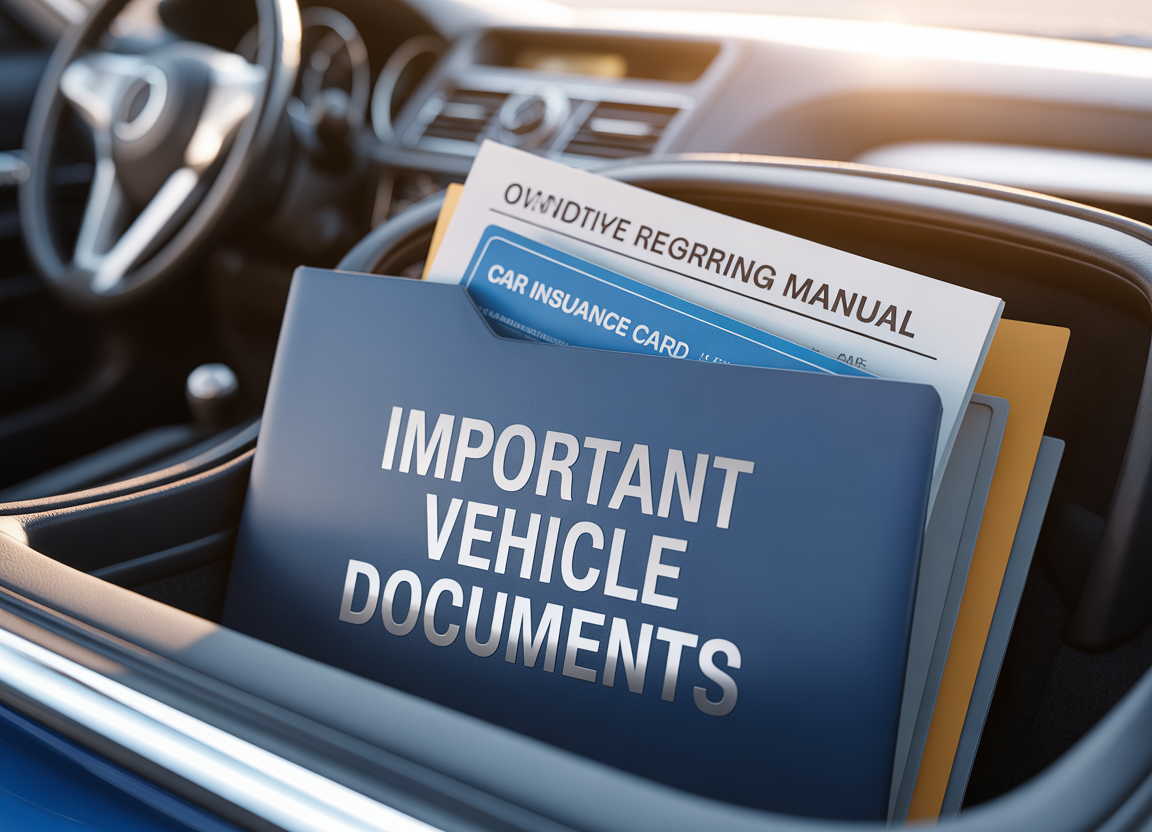
The goal of a good glovebox setup is not to store everything. It is to keep the small number of documents and notes you may need quickly during a traffic stop, a breakdown, or a crash, while keeping more sensitive originals in a safer place. AAA’s glove-compartment guidance and insurer checklists both support that “only the essentials” approach. (AAA Club Alliance)
A simple glovebox folder that makes sense
For most U.S. drivers, the most useful items to keep in the car are:
- current vehicle registration
- proof of insurance
- roadside assistance contact details
- a short emergency contact / medical information card
- a one-page accident information sheet
- the owner’s manual or a short printed quick-reference sheet
AAA recommends keeping registration, proof of insurance, and the owner’s manual in the glove compartment, and Nationwide also lists proof of insurance, owner’s manual information, medical information, and emergency contacts among useful glovebox items. (AAA Club Alliance)
A good internal-link upgrade for this section is to link to your own roadside kit checklist and what to do after a crash guide.
Registration: keep the current one easy to reach
Your current registration is one of the most commonly needed vehicle documents. AAA specifically includes registration among the core items to keep in the glove compartment, and DMV guidance makes clear that registration and insurance documents need to match the vehicle. If you renew, swap the old copy out the same day so you are not carrying expired paperwork. (AAA Club Alliance)
The smarter wording here is not “everyone must store registration in the glovebox.” It is: keep your current registration somewhere in the vehicle where you can access it quickly and safely, and follow your state’s rules and your own theft-risk comfort level. AAA itself notes that requirements can vary by state. (AAA Club Alliance)
Insurance proof: paper plus digital is the safest setup
Proof of insurance belongs in your quick-access folder. New York DMV says anyone who operates the vehicle must be able to provide proof of insurance, and AAA includes proof of insurance among the core glovebox items. (NY DMV)
A strong practical setup is:
- a paper insurance card or printed proof in the vehicle
- a digital copy on your phone as backup
Digital proof is widely accepted in the U.S., but even insurers that promote digital cards still say it is smart to carry a paper copy because dead batteries, broken screens, or signal issues happen. (State Farm)
Roadside assistance details should be written down, not just “saved somewhere”
If you have roadside assistance through AAA, your insurer, your carmaker, or a credit card, keep the essentials where you can grab them under stress:
- provider name
- phone number
- member or policy number
- app name if the service is app-based
- any useful limits, such as towing-distance caps
AAA’s glovebox guidance and roadside-oriented articles both support keeping quick-help information and basic emergency items in the vehicle. (AAA Club Alliance)
An emergency contact card is small, but genuinely useful
An ICE card with emergency contacts and brief medical information can be helpful if your phone is locked, dead, or unavailable. The American Red Cross offers an emergency contact card template and recommends that people fill one out and carry it for use during emergencies. (American Red Cross)
A clean version for a glovebox folder should stay short:
- your name
- two emergency contacts
- key allergies
- major medical conditions
- essential medications, if relevant
The point is fast readability, not a full medical file. The Red Cross template supports the idea of a concise emergency card rather than a thick document packet. (American Red Cross)
A one-page accident sheet is worth more than most people think
After a collision, people often forget small but important details. A one-page accident info sheet helps you stay organized when you are stressed.
In a non-injury collision, NYC’s official guidance says drivers are responsible for exchanging driver’s license information, insurance, and vehicle registration with the other motorists involved. That makes a simple printed reminder practical, even though exact legal requirements vary by jurisdiction. (New York City Government)
A useful accident sheet should remind you to collect:
- photos of the vehicles, plates, and wider scene
- the other driver’s contact and insurance information
- witness names and phone numbers
- time, location, and weather
- a short description of what happened
Keep a pen with it. That is not a law; it is just one of the cheapest ways to make the sheet actually useful.
The owner’s manual still belongs in the car
AAA includes the owner’s manual among glovebox essentials because it contains basic operating and maintenance information you may need quickly. That is especially useful for warning lights, tire pressure, jack points, or fuse-box basics. If you do not want to keep the full manual in the car, a one-page quick-spec sheet can still be useful. (AAA Club Alliance)
A good quick-spec page can include:
- tire pressures
- oil specification
- spare tire and jack location
- tow hook location
- roadside assistance number
That is a good place to add an internal link to your own tire pressure guide or dashboard warning light guide.
What not to keep in the glovebox
This is the part many weaker articles get wrong by being too vague.
A vehicle title should not live in the car. New York DMV says it is wise to keep your title certificate in a safe place and explicitly says not to keep it in the car or carry it with you. (NY DMV)
You should also avoid storing highly sensitive or theft-prone items in the glovebox, such as:
- passports
- Social Security cards
- banking information
- spare house keys
Those are best left out of the vehicle entirely. That advice is common-sense security rather than a state-specific DMV rule, but it is a strong privacy practice.
Your driver’s license should stay on you, not in the glovebox. That is practical advice rather than a specialized citation need: you may need to present it when away from the car, and it is not useful if it is locked in a stolen or inaccessible vehicle.
Paper versus digital: use both, not one or the other
A clean, realistic setup is paper in the glovebox, digital on the phone. Insurers like State Farm and Progressive both note that digital proof is widely accepted, while also acknowledging that paper copies remain useful. AAA similarly advises drivers to check state requirements, especially if traveling out of state. (State Farm)
That makes the best practice straightforward:
- paper for reliability
- digital for backup
A simple way to organize the folder
A glovebox works better when it is treated like a small document holder, not a junk drawer.
A simple setup:
- registration and insurance in front
- roadside info next
- ICE card and accident sheet behind those
- owner’s manual or quick-reference page at the back
Review it twice a year and remove expired cards or outdated numbers. That is practical maintenance advice, and it helps keep the folder usable when you actually need it.
Bottom line
A smart glovebox is not full. It is ready.
For most U.S. drivers, the most useful glovebox folder contains:
- current registration
- proof of insurance
- roadside assistance details
- an emergency contact card
- a one-page accident sheet
- the owner’s manual or a quick-reference page
Keep the title at home, keep truly sensitive documents out of the car, and use paper plus digital backups where it makes sense. AAA, DMV guidance, Red Cross emergency-card templates, and official collision-info guidance all support that more practical approach. (AAA Club Alliance)