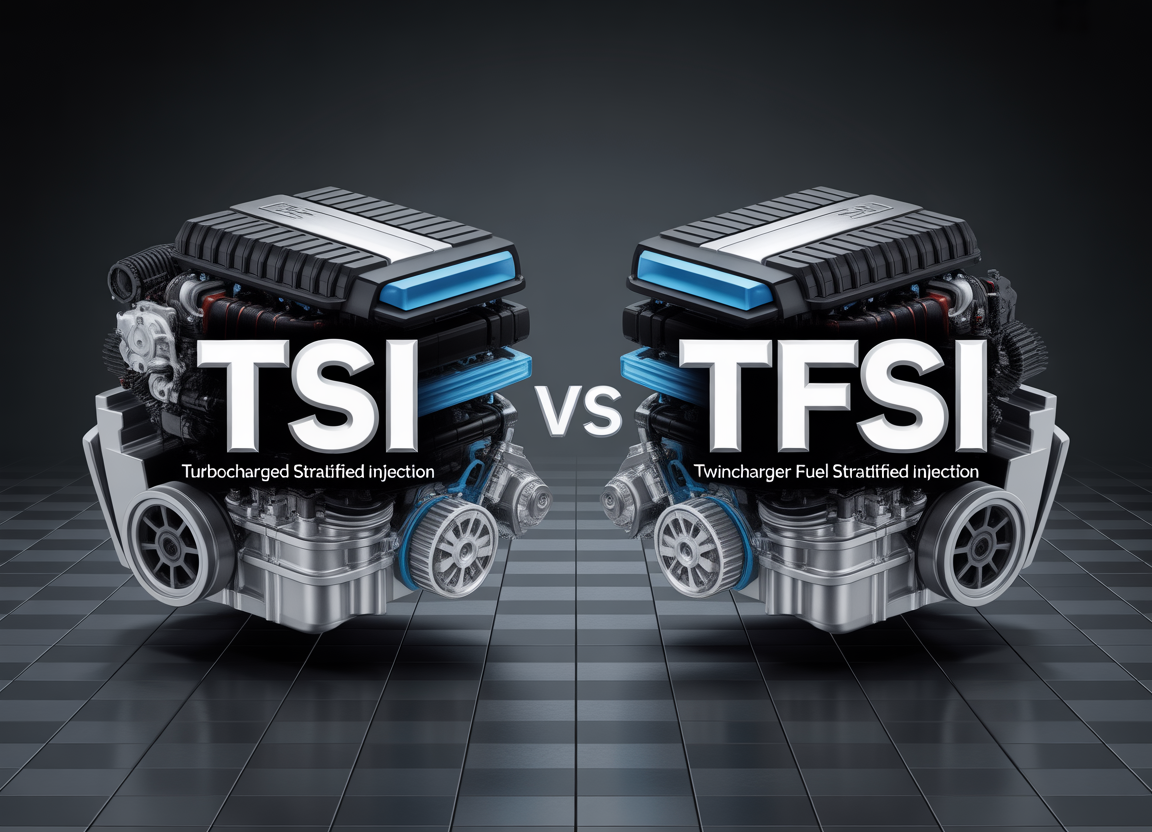
The major difference between both engines is that the TFSI badge is typically used on Audi petrol engines, while TSI is typically used on Volkswagen (and sometimes Skoda/SEAT) petrol engines. But both badges usually refer to the same core idea: a turbocharged petrol engine using (primarily) direct fuel injection, designed for strong performance and good efficiency.
By Gustavoblalmiras • Last updated: March 2026
This article is for educational and general information only.
So… which one is more superior and reliable? In most real-world cases: neither badge is automatically better. What matters is the specific engine family (EA111, EA888, EA211, etc.), its generation, its maintenance history, and how it’s been driven—because Audi and VW often share engine architectures across the Volkswagen Group.
Quick verdict (if you just want the answer)
- “Superior” (power/feel): usually depends on tuning and hardware (turbo size, intercooler, calibration), not whether the badge says TSI or TFSI.
- “Reliable”: depends far more on the engine code/generation and service history than on the badge.
- Rule of thumb: a well-maintained newer-generation TSI/TFSI is usually a safer bet than an older neglected one—regardless of brand.
What do TSI and TFSI actually mean?
TSI (Volkswagen branding)
Volkswagen has used TSI to describe turbo petrol engines that combine turbocharging with direct injection, sometimes described as “turbocharged stratified injection” in VW materials. Source: Volkswagen Newsroom.
TFSI (Audi branding)
Audi uses TFSI as its petrol-engine technology label, often expanded as “turbo fuel stratified injection” in Audi materials. Source: Audi MediaCenter.
Plain-English translation: both badges generally point to a turbocharged direct-injection petrol engine. In many models they’re closely related—or even the same engine family—just branded differently.
Are TSI and TFSI the same engine?
Sometimes they can be extremely similar because VW, Audi, Skoda, and SEAT share platforms and engines across the VW Group. But “TSI” and “TFSI” are umbrella labels—not one single engine. Two cars can both say “TSI” and still have very different long-term reliability depending on the engine code, generation, and service history.
What actually makes one TSI/TFSI “better” than another?
These factors matter far more than the badge:
1) Engine family & generation (this is the biggest factor)
Example: the popular EA888 family has multiple generations, and each generation has its own patterns of known issues and improvements. (NHTSA-hosted documents often include technical details for specific engines/years.) Example document: NHTSA PDF.
2) Timing drive design (and the tensioner design)
Some VW Group engines use timing chains, some use belts, and some years have better hardware than others. Timing-chain tensioner/chain problems have been discussed in manufacturer technical documentation for certain engines/years. Example document: NHTSA PDF.
3) Injection strategy (direct only vs mixed injection)
Direct injection is efficient and punchy, but it can contribute to intake-valve deposits over time. Some later VW Group designs used additional strategies (including mixed injection in some applications/markets) to reduce certain side effects and meet emissions requirements. Example document: NHTSA PDF.
4) Cooling & turbo hardware (and how hard it’s tuned)
Different models get different turbos, intercoolers, boost targets, and calibrations. So “superior” performance is often just a stronger state of tune—not “TSI vs TFSI.”
Reliability: common problems to watch for (and what to check)
These are common buyer checks that matter on many VW Group turbo direct-injection petrol engines. Not every engine has every problem—this is why engine code + service history matters.
Problem 1: Timing chain / tensioner issues (some engines/years)
Some engines/years have documented timing-related issues in technical paperwork. Example documents: NHTSA PDF (timing) and NHTSA PDF (diagnosis guidance).
What you’ll notice
- Rattle on cold start
- Engine light + timing-related fault codes
- Rough idle or poor running
What to do as a buyer
- Do a true cold start if possible (don’t let the seller warm it up first).
- If the engine family/year is known for timing issues, prefer cars with documented timing work or strong service records.
- Get a specialist pre-purchase inspection (scan + mechanical checks).
Problem 2: Oil consumption (important on some engines)
Oil consumption can happen on many turbo engines. Some VW/Audi applications have enough history that manufacturers published formal measurement procedures and service steps for certain engines/years. Example document: NHTSA PDF (oil consumption procedure).
Buyer checklist
- Ask how often the owner tops up oil (and whether they have receipts/notes).
- Check for oil warning history and visible oil leaks.
- Verify correct oil spec and sensible service intervals.
Problem 3: Water pump / coolant leaks (common enough to check)
Cooling leaks can be a recurring pain point on some VW Group turbo petrol engines. Example document: NHTSA PDF (coolant leak/water pump guidance).
Symptoms
- Low coolant warning
- Coolant smell, crusty residue near pump/thermostat housing, or puddles under the car
Buying tip
- Look for dried residue and check coolant level when the engine is cold.
- Receipts matter more than “it was done recently” claims.
Problem 4: High-pressure fuel pump / cam follower wear (older designs)
On some older VW/Audi 2.0T designs, wear at the cam follower interface can cause fuel system problems if it progresses far enough. Example document: NHTSA PDF (HPFP/cam follower inspection guidance).
Who should care most: buyers of older performance-era 2.0T engines (especially modified cars). If you’re unsure, get a specialist inspection.
Problem 5: Carbon buildup / deposit-related drivability issues
Direct injection engines can develop intake-valve deposits over time because fuel doesn’t wash the back of the valves like port injection does. Typical symptoms can include rough idle/misfires and reduced performance. (Design discussions appear in various technical documents; example: NHTSA PDF.)
Buyer tip: if a car idles rough, misfires, or has inconsistent power delivery, don’t guess—scan it and have it inspected.
So… which is more reliable: TSI or TFSI?
You can’t rank reliability by the badge alone. TSI and TFSI engines overlap heavily in design across the VW Group. Reliability differences show up more clearly when you compare:
- engine code + generation,
- service history,
- known weak points for that specific setup,
- how it’s been driven and maintained.
The practical buyer advice
- Prioritize service history (correct oil spec, realistic intervals, receipts).
- Prefer newer generations when budget allows (they often incorporate fixes/improvements).
- Get a specialist inspection for higher-mileage turbo engines (scan + mechanical checks).
- Avoid mystery cars with missing records, warm-engine-only viewings, or “just needs a sensor” stories.
How to identify what TSI/TFSI you’re actually buying (engine code)
If you want a reliable decision, find the engine code (and ideally the exact engine generation). Depending on model/market, you can often find it in:
- the service book or dealer printouts
- the vehicle data sticker (often in the spare wheel well or service book)
- OBD scan results / diagnostic report
Once you have the engine code, you can research known patterns and ask smarter questions (timing work, water pump history, oil consumption history, etc.).
Buying checklist (print-this style)
- Cold start: any chain rattle? rough idle? warning lights?
- Scan for codes: misfires, timing correlation, fuel pressure faults
- Oil history: top-ups, oil warnings, correct oil spec, interval proof
- Coolant: level when cold + signs of leaks/residue
- Service records: invoices beat stamps
- Modifications: tuned cars can be fine, but only if maintained well and kept emissions-legal in your region
Maintenance habits that genuinely improve longevity
- Use the correct manufacturer oil spec and don’t stretch intervals.
- Warm up gently before hard boost (especially on cold days).
- Don’t ignore small coolant losses—cooling leaks rarely fix themselves.
- Treat persistent startup rattle, misfires, or repeated fault codes as “inspect now,” not “later.”
Bottom line
TSI vs TFSI isn’t really the rivalry people think it is. In many cases it’s the same engineering idea—and sometimes the same engine family—wearing different brand clothing.
If you want the most reliable choice, ignore the badge and shop the best engine generation + best-maintained example you can find.
Sources
- Volkswagen Newsroom: TSI EVO engine
- Audi MediaCenter: TFSI tag page
- NHTSA PDF: timing-chain related technical document
- NHTSA PDF: timing diagnosis guidance document
- NHTSA PDF: oil consumption measurement/service document
- NHTSA PDF: coolant leak/water pump document
- NHTSA PDF: HPFP/cam follower inspection document
- NHTSA PDF: EA888-related technical document