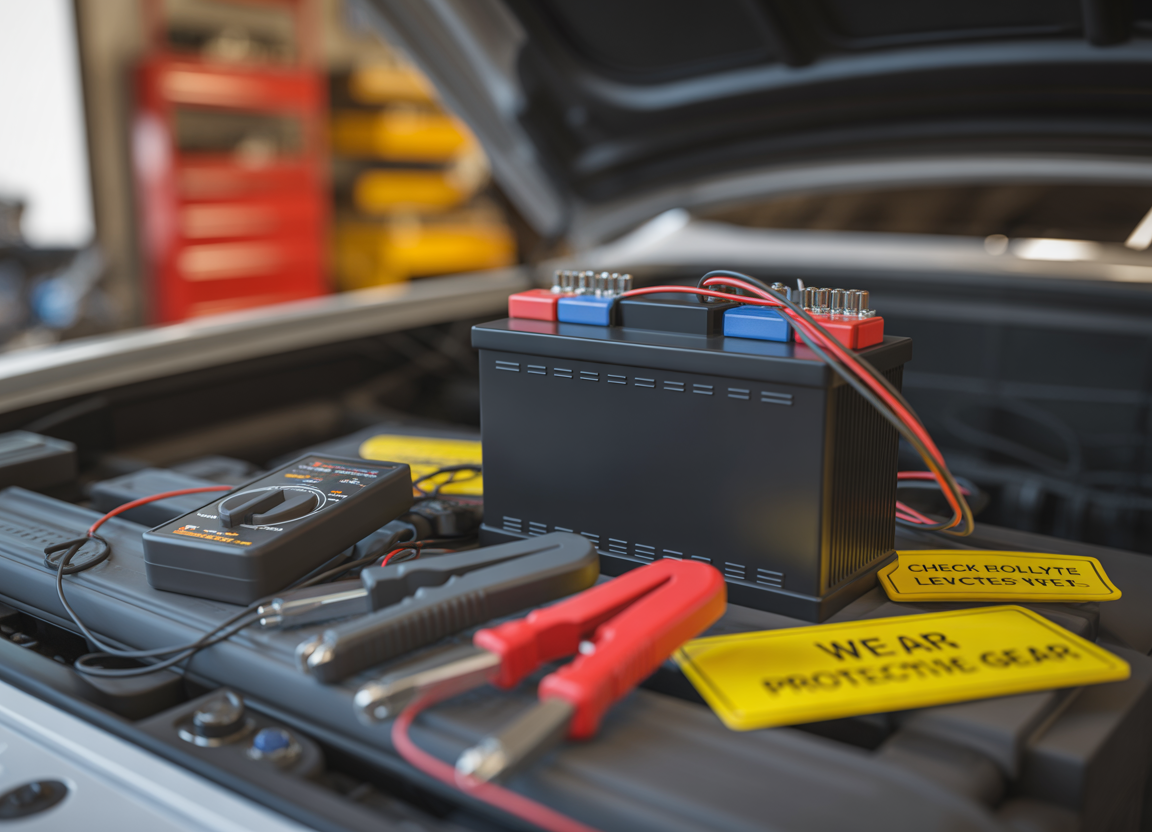
The three most common causes of ignition clicks are a defective starter, alternator, or (most often) the battery. The starter needs strong battery power to spin the engine—so when the battery can’t deliver enough current, you often hear that dreaded click-click-click (the starter solenoid trying to engage). A dead or dying battery is one of the most common reasons a car won’t start. (AAA)
By Gustavoblalmiras • Last updated: March 2026
This article is for educational and general information only.
But here’s the real question: do “dead car battery tricks” actually exist—like social media hacks that magically revive a battery?
Some do (in a practical, safe sense). Most don’t. The best “trick” is knowing whether you have:
- a discharged battery (can usually be jump-started or properly charged), or
- a failed battery (won’t hold charge and needs replacing), or
- a charging/starting problem (alternator, wiring, starter, or bad connections).
Let’s break it down in a way that saves time, money, and stress.
First: what does “dead battery” really mean?
People say “dead battery” for multiple situations:
1) Discharged battery (often fixable today)
You left lights on, the car sat too long, it was very cold, or there’s a parasitic drain. The battery may still be healthy—just empty.
2) Weak/failed battery (temporary fixes won’t last)
It might jump-start once, then die again. If it can’t hold charge, you’re on borrowed time.
3) Not the battery at all
Clicking can also come from loose/corroded terminals, a bad alternator, or a starter issue. (Firestone Complete Auto Care)
So… do battery “tricks” exist?
Yes—legit tricks exist, but they’re really just basic diagnostics and correct procedures. The viral “hack” tricks (aspirin, soda, banging the battery, pouring liquids) are mostly myths or unsafe.
Below are the ones that actually work.
The real “dead battery tricks” that work
Trick #1: Clean and tighten the battery terminals (often solves “click but no start”)
A weak connection can mimic a dead battery. If the clamps are loose or there’s corrosion, the starter can’t get enough current—even if the battery has charge.
Signs this is your issue
- Lights come on, but it clicks and won’t crank
- Wiggling the terminal makes lights flicker
- White/blue crust on terminals
Corroded or loose battery terminals are a common cause of clicking/no-start. (Firestone Complete Auto Care)
Quick fix (safe version)
- Turn the car off and remove the key.
- Check the clamps: they should be tight and not rotate by hand.
- If corrosion is heavy, use proper terminal cleaner or baking soda + water on the terminals only (avoid splashing). Dry afterward.
Safety note: batteries can vent flammable hydrogen gas—avoid sparks and flames near the battery. (CCOHS)
Trick #2: Jump-start correctly (the #1 real fix for a discharged battery)
A correct jump-start is not a gimmick. It’s a proven method—if done safely and your battery is only discharged (not failed).
Key safety points
- Hydrogen gas can ignite from a spark. (CCOHS)
- Do not jump-start a frozen battery (explosion risk). Check your owner’s manual. (Example manual warning: Mazda manual page)
Important detail most people miss
Many roadside guides recommend connecting the final negative clamp to a solid earth point (unpainted metal on the engine block/chassis), not the dead battery’s negative post, to reduce sparking near the battery. (The AA)
If it still won’t start after connecting
Let the donor car/jump pack stay connected for a few minutes before cranking. Some deeply discharged batteries need a brief “surface charge” first.
Trick #3: Turn everything off before starting (small change, big help)
This sounds basic, but it matters when power is limited. Before you crank, turn off:
- headlights
- heated seats
- rear demister
- blower fan
- phone chargers and accessories
You’re giving the starter motor the best shot with the battery you have.
Trick #4: Use a proper charger (not “drive it and hope”)
If you jump-start and then only drive a short trip, the battery may not recharge enough. Many modern cars also draw power even when “off.”
A smart charger (or maintainer) is often the real solution for a car that sits.
Why driving isn’t always enough
The alternator’s job is to power the electrical system and keep the battery charged while the engine runs. (Firestone: What does an alternator do?) But if the battery is deeply discharged—or you only do short trips—it may not fully recover.
Trick #5: Quick voltage check with a multimeter (fastest way to stop guessing)
You don’t need to be a mechanic to do this. A healthy resting 12V lead-acid battery is commonly around 12.6V when fully charged. (Kwik Fit)
Rule of thumb (resting voltage, engine off, after the car has sat for a while):
- 12.6V+ = roughly full
- 12.4V = partly discharged
- 12.2V = significantly discharged
- 12.0V = very low
Reality check: Voltage alone isn’t everything—starting needs amps—but voltage gives you a quick clue whether you’re dealing with “discharged” vs “something else.”
Tricks that sometimes work (only in specific cases)
“Tap the starter” trick (not a battery fix)
Sometimes a worn starter motor has a dead spot, and a gentle tap can temporarily get it moving. This is not a long-term repair—and it’s not a battery trick.
When to suspect starter instead of battery
- One loud click, but lights stay bright
- Battery voltage looks healthy
- Jump-start doesn’t help
Treat it as a diagnosis clue, not a solution.
Push-starting a manual car (limited scenarios only)
If you drive a manual transmission vehicle, a push/bump start can work when the battery is weak but not completely dead. It won’t help if the battery is totally flat, the car is automatic, or the vehicle is hybrid/EV (don’t attempt). Use only if safe and legal where you are.
Battery “tricks” that are myths (or risky)
Myth 1: “Just rev the donor car hard to charge faster”
Not necessary and can be risky depending on the vehicles. Follow established guidance instead. (RAC jump-start guide)
Myth 2: “Pour hot water on the battery / add aspirin / add salt”
These hacks can create corrosion, damage components, or cause injury. Don’t do it.
Myth 3: “Disconnect the battery to reset it”
Disconnecting can clear some electronic states, but it doesn’t recharge a dead battery. It can also reset systems and create new issues in modern cars.
If it keeps dying: the 3 real causes (and what to check)
1) The battery is worn out
Car batteries don’t last forever. A battery can show “okay voltage” but still fail under load.
Clues
- It jump-starts but dies again soon
- It struggles in cold weather
- You frequently need boosts
AAA notes battery/alternator issues are among the most common reasons cars won’t start. (AAA)
2) The alternator isn’t charging
If the alternator is weak, the car may start after a jump, then die while driving or the next morning. Alternators supply electricity and recharge the battery while the engine runs. (Firestone)
Clues
- Battery light on the dashboard
- Headlights dim with engine running
- Voltage doesn’t rise with the engine running (often it should be higher than resting)
3) Parasitic drain (something drains it while parked)
Common culprits include:
- dash cams wired incorrectly
- interior lights staying on
- faulty door latch switches
- aftermarket stereos/alarms
If the battery is healthy and the charging system is fine, this is the next thing to test (a proper parasitic drain test).
The safest “do this now” checklist
If your car is clicking and won’t start:
- Check terminals (tight, clean, no heavy corrosion). (Firestone)
- Try a proper jump start (final negative to a good ground point). (RAC)
- If it starts: charge properly (drive long enough or use a smart charger—short trips often aren’t enough).
- If it won’t start: stop cranking repeatedly (you can overheat the starter) and get the battery load-tested.
- If the battery is old/weak: replace it, then verify alternator charging.
FAQ
Is clicking always a dead battery?
Not always, but it’s one of the most common causes. Loose/corroded terminals, a bad alternator, or a starter fault can also cause clicking/no-start. (Firestone)
Can a jump start damage my car?
It can if done incorrectly or if the battery is damaged/frozen. Follow proper grounding steps and safety warnings about hydrogen gas. Check your owner’s manual for your vehicle’s recommended method.
If it starts after a jump, is the battery “fixed”?
Not necessarily. If the battery won’t hold charge (or the alternator isn’t charging), you’ll be back in the same situation soon.
About the author
Gustavoblalmiras publishes practical car maintenance and troubleshooting guides at DriversAdvice.com. For corrections or updates, please use the site contact page.