By Gustavoblalmiras
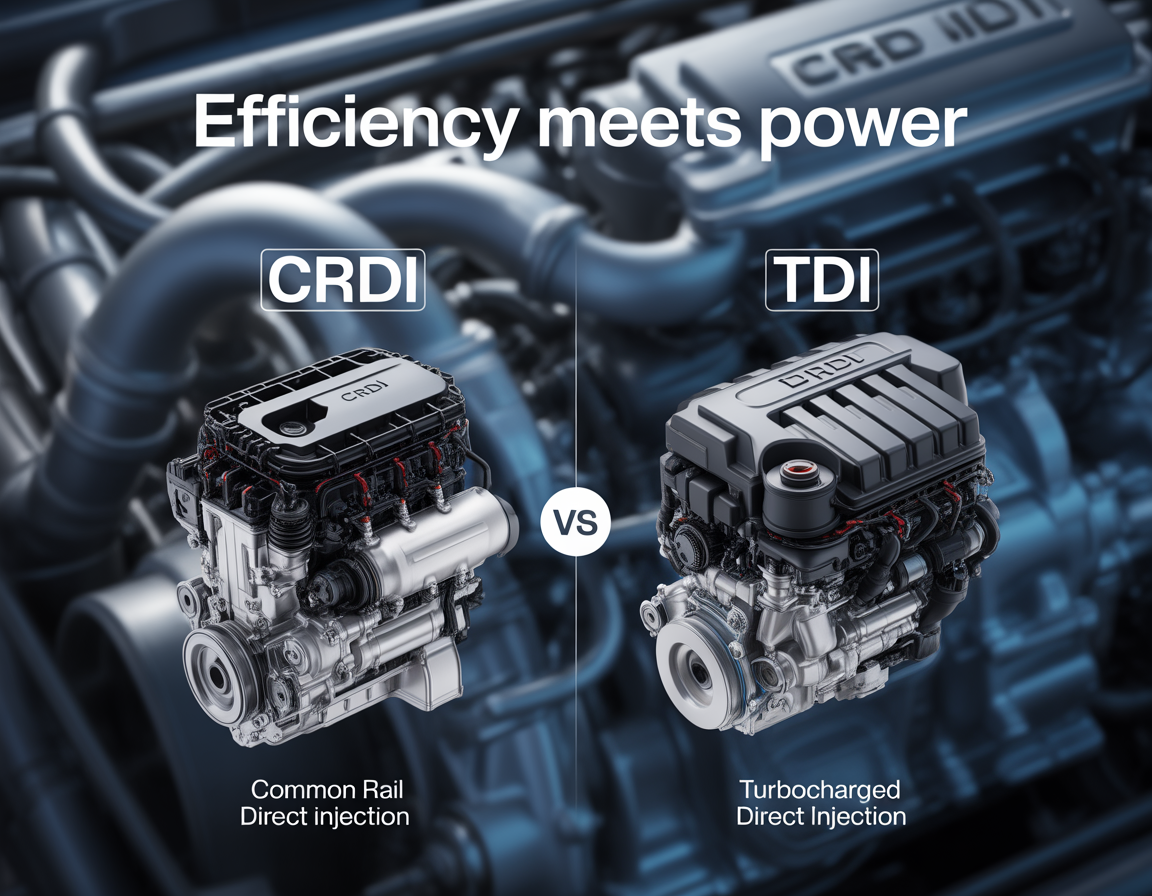
Common Rail Direct Injection is often abbreviated as CRDI (you’ll also see CRDi/CRD depending on brand), and TDI is a well-known label used mainly by the Volkswagen Group for turbocharged, direct-injection diesel engines.
This is only for educational purposes.
Here’s the twist most people miss: CRDI and TDI aren’t direct competitors because they describe different things.
- CRDI describes an injection system architecture: a high-pressure pump feeds a shared fuel “rail,” and the ECU controls the injectors electronically.
- TDI is an engine family badge/label (mostly VW/Audi/SEAT/Škoda). Many modern TDIs are also common-rail, meaning they use a CRDI-style injection system.
So the real comparison is usually one of these:
- Common-rail diesel (CRDI) vs older non-common-rail VW TDI eras (like PD/unit injector).
- VW-Group TDI ownership vs other brands’ common-rail diesels (Hyundai/Kia CRDi, Mercedes CDI, Peugeot HDi, Fiat/Alfa JTD, etc.).
This guide compares them the right way: what the terms mean, what changes between diesel generations, common problems, and how to decide what’s best for your driving.
Important legal/safety note: This article does not recommend or explain emissions tampering (DPF/EGR “delete” procedures, defeat devices, etc.). Those modifications can be illegal, can cause inspection failure, and can create expensive drivability issues. Always follow local laws and manufacturer guidance.
The 30-second answer
- For refinement and injection precision: modern common-rail (CRDI) systems generally win because they enable very flexible, electronically controlled injection strategies.
- For “which is more reliable”: it depends more on the specific engine family, maintenance history, fuel quality, and emissions-system condition than the badge “CRDI” or “TDI.”
- Key reality: many “TDI” engines are common-rail TDIs, so “CRDI vs TDI” is often comparing two different categories (system vs brand/engine label).
What CRDI actually means
Common-rail direct injection means fuel is pressurized by a high-pressure pump and stored in a shared rail (an accumulator). The engine computer (ECU) commands each injector electronically—controlling timing, duration, and often multiple injections per cycle.
Why common-rail became the mainstream
Common-rail is popular because it gives engineers more control over combustion. That can translate to:
- Smoother running (pilot injections can reduce diesel knock)
- Better emissions strategy control (more precise burn control helps manage soot/NOx tradeoffs)
- More flexibility across different loads, temperatures, and driving styles
CRDI also isn’t one brand—it’s an architecture used across many manufacturers with different calibrations, injectors, and emissions packages.
What TDI actually means
TDI is primarily a Volkswagen Group label for turbocharged, direct-injection diesel engines. Over the years, “TDI” has included multiple injection generations (older distributor-pump styles, the PD/unit-injector era, and modern common-rail versions).
Key point: a car can be both TDI and CRDI
A modern VW-Group “TDI” is often:
- Turbocharged
- Direct injected
- Common-rail (CRDI-style fuel delivery)
So if someone says “CRDI vs TDI,” they often mean “common-rail vs older non-common-rail TDI systems” or “VW TDI ownership vs other brands.”
CRDI vs TDI: what’s actually different?
1) System vs label
- CRDI = injection strategy/hardware (rail + HP pump + electronically controlled injectors)
- TDI = engine lineup label (usually turbo + direct injection; injection design depends on era)
2) Emissions equipment often matters more than the badge
Modern diesels—TDI or not—often include combinations of:
- EGR (exhaust gas recirculation)
- DPF (diesel particulate filter)
- SCR/AdBlue on many newer models
These systems can dominate real-world reliability—especially for short-trip drivers.
Common-rail vs older VW TDI systems (PD/unit-injector era)
Older VW TDIs included the PD (Pumpe-Düse / unit injector) era, where each injector was mechanically pressurized by the engine. It can deliver very high injection pressures, but it’s less flexible than common-rail in how it shapes injection events.
Common-rail advantages (typical)
- Multiple injection pulses per cycle (pilot/main/post injections)
- Smoother, quieter combustion feel
- More flexibility for emissions strategies and drivability mapping
PD/unit injector advantages (typical)
- High pressure at the injector without a shared rail
- Can be robust when maintained correctly, but can be sensitive to oil specifications and wear patterns (engine-dependent)
Bottom line: If you’re comparing common-rail vs older non-common-rail TDIs, common-rail usually wins for refinement and control. But “reliability” still comes down to the specific engine and its maintenance history.
Reliability: what commonly fails on CRDI systems?
CRDI systems operate at extremely high pressures and tight tolerances. That brings efficiency and control—but it also means contamination and wear can be costly.
Common CRDI pain points (across many brands)
- High-pressure fuel pump (HPFP) issues
Symptoms can include hard starting, rail-pressure faults, stalling, or metal contamination in severe cases. - Injector wear/leakback
Symptoms: rough idle, smoke, poor MPG, hard starts, uneven running. - Fuel contamination sensitivity
Water, dirty fuel, or misfueling can damage high-pressure components faster than older systems. - Emissions system issues (DPF/EGR/SCR)
Often the #1 real-world issue for short-trip driving and neglected maintenance.
How to make a CRDI diesel last longer
- Change the fuel filter on schedule (or earlier in harsh conditions)
- Use good fuel and avoid running the tank nearly empty repeatedly
- Follow correct oil spec and service intervals (important for turbo + emissions longevity)
- Give the car occasional longer runs if it has a DPF (if your driving pattern allows)
Reliability: what commonly fails on TDI engines?
Because “TDI” spans generations, failures depend heavily on engine code, year, and emissions setup. Still, these categories show up often in ownership discussions:
- Fuel system issues (especially on some common-rail eras)
HP pump or injector problems can be expensive because the system is interconnected. - EGR/DPF/SCR-related faults
Short trips and stop-start driving can accelerate soot loading and regeneration stress. - Turbo/boost control issues
Symptoms: limp mode, underboost/overboost faults, hissing/whistling, low power under load. - Timing belt risk (where belt-driven)
Missing belt history is a serious used-car risk on many diesel engines (not just VW).
Performance and efficiency: what actually changes on the road?
If you’re talking about everyday performance, the biggest factors are:
- Turbo system design (boost response, torque curve)
- Injection control quality (smoothness, smoke control, low-speed drivability)
- Emissions strategy (how the car behaves during regen, EGR operation, etc.)
Common-rail helps because it can shape injection events more precisely—often improving refinement and drivability. But a well-maintained TDI can be excellent too, especially if the engine code has a strong reliability record and the car has been serviced correctly.
Which is “best” for your driving pattern?
This is the decision that prevents most buyer regret:
Mostly short trips (city, school runs, 5–10 miles)
Modern diesels—CRDI or TDI—can be a poor match if they have DPF/SCR systems that rarely get fully hot. You may face more DPF/EGR issues over time. If your driving is mostly short trips, consider whether a petrol, hybrid, or EV is a better fit.
Mixed use (city + weekly longer run)
A modern diesel can work well if it regularly gets longer drives that allow normal operating temperature and stable highway cruising.
Mostly motorway/highway mileage
This is where diesels often shine: strong torque, efficient cruising, and fewer DPF complaints when the system is regularly operating as designed.
Used-buyer checklist (works for CRDI and TDI)
Whether you’re buying a “CRDI” Hyundai/Kia or a VW “TDI,” use this checklist to avoid the expensive surprises.
- Identify the exact engine
Don’t rely on badges. Get the engine code (or at least the displacement + power output + year) and look up common issues for that specific family. - Scan the car (even if no dash lights)
Stored faults for rail pressure, injector balance, EGR/DPF, boost control, or SCR can tell you more than a clean dashboard. - Check service history for the basics
Oil spec, oil interval, fuel filter changes, and timing belt history (if applicable). - Watch the cold start
Excessive cranking, rough idle, strong diesel knock, or heavy smoke can indicate fuel, glow, or compression/injector issues. - Test drive under load
Do a steady pull in a higher gear. Look for limp mode, hesitation, or whistling/hissing (boost leaks). - Check for DPF behavior signs
Frequent fans running after shutdown, repeated warning lights, or “it keeps regenerating” stories can signal short-trip stress or sensor issues. - Avoid mystery “tuning” stories
Unclear modifications can complicate diagnosis and resale, and emissions-related tampering can be illegal and costly.
Symptom guide (fast troubleshooting thinking)
| Symptom | Common causes (not exhaustive) | What to do |
|---|---|---|
| Hard starting (especially cold) | Glow system issues, injector leakback, rail pressure problems, weak battery | Scan codes + check battery health + fuel filter history |
| Rough idle / misfire feel | Injector imbalance, EGR issues, air leaks, mounts | Check injector balance data if available; inspect intake/boost hoses |
| Limp mode under load | Boost control faults, EGR/DPF faults, sensors (MAF/MAP), vacuum leaks | Scan codes; check hoses, vacuum lines, and boost leaks |
| DPF warning / frequent regens | Short trips, soot loading, failed sensors, EGR issues | Confirm driving suitability; diagnose sensors; fix root cause early |
| Fuel smell / smoke / poor MPG | Injector sealing, boost leaks, regen issues, sensor faults | Inspect for leaks; scan live data; avoid “quick fixes” |
FAQ
Are CRDI and TDI the same thing?
No. CRDI refers to a common-rail injection system. TDI is mainly a VW-Group engine label for turbocharged, direct-injection diesels. Many TDIs are common-rail—so a car can be both.
Which one is more reliable?
Neither badge guarantees reliability. The biggest predictors are engine family reputation, maintenance history (oil spec, fuel filters, timing belt), and whether the car’s emissions hardware matches your driving pattern.
Is common-rail always better than older systems?
Common-rail typically offers better refinement and control, but older systems can be very durable. “Better” depends on your priorities: refinement/emissions control vs simplicity, plus how well the specific engine has been maintained.
Should I buy a diesel if I only do short trips?
Often no. Many modern diesels (TDI or CRDI) can struggle with short-trip use due to DPF/EGR/SCR system behavior. If you rarely drive longer routes, a petrol or hybrid may be a better ownership match.
Conclusion
“CRDI vs TDI” is usually the wrong comparison because CRDI is a fuel-injection system while TDI is a VW-Group diesel label. Many modern TDIs are common-rail. If you want the best outcome, compare specific engines, verify service history, match the diesel to your driving pattern, and treat emissions-system health as a core part of reliability—not an afterthought.