Last reviewed: 20, March 2026
Editorial note: This guide is for general information only and is not a substitute for a professional inspection or manufacturer service guidance.
Scope: This article is about light-duty passenger-car diesel engines sold in markets where CRDI and TDI terminology is common, especially Europe, India, and similar markets. It is not a guide to one specific engine code or one specific model year. That matters because TDI is mainly a Volkswagen Group engine label used across different diesel generations, while common rail is an injection-system architecture used by many brands. Volkswagen’s own historical material shows that older TDI eras included pump-nozzle / unit-injector engines before Volkswagen transitioned many TDI engines to common rail. (Volkswagen Newsroom)
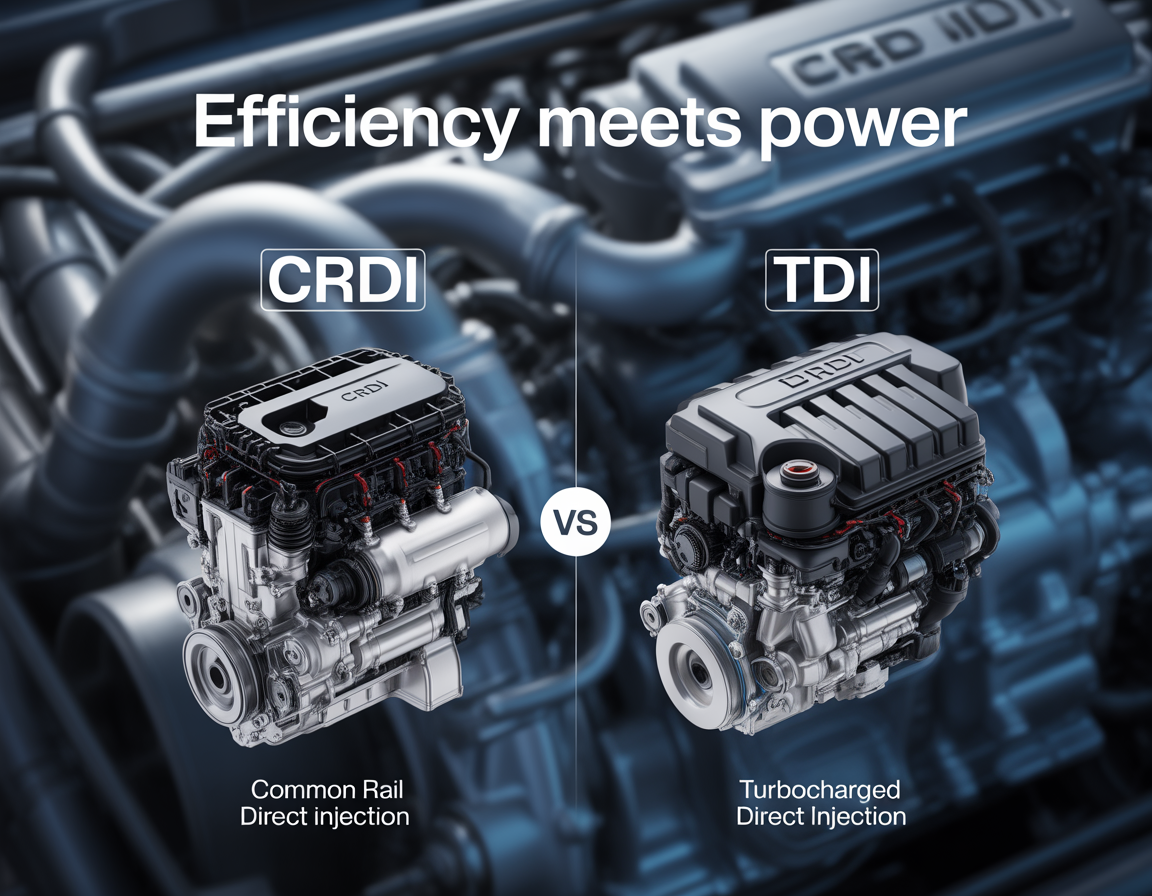
A cleaner way to frame the topic is this: CRDI and TDI are not true badge-versus-badge rivals. CRDI describes how fuel is delivered. TDI describes a family or badge of turbocharged direct-injection diesel engines, mainly from the Volkswagen Group. Many modern TDI engines are also common-rail engines, which means a car can be both TDI and common rail at the same time. Volkswagen’s own material explicitly describes newer TDI engines as using common-rail fuel injection, and Bosch describes common rail as the most widely used high-pressure diesel injection system it produces. (Volkswagen Newsroom)
What CRDI actually means
Common Rail Direct Injection means fuel is pressurized by a high-pressure pump, stored in a shared rail, and then electronically metered to each injector. Bosch’s technical description says the primary advantage of common rail is the flexibility of injection pressure and injection timing, made possible by separating pressure generation from injection. Bosch also explains that the fuel is kept at high pressure in the rail and then distributed to the injectors, with timing and quantity controlled individually for each cylinder. (Bosch Mobility)
That flexibility is the reason common rail became the mainstream diesel architecture. Bosch says it allows very high injection accuracy and multiple injections per cycle, while Volkswagen says common-rail injection contributes to smoother and quieter combustion on its later TDI engines. In plain language, that usually means better refinement, better combustion control, and more flexibility for emissions and drivability tuning than many older diesel injection setups. (Bosch Mobility)
What TDI actually means
TDI is mainly a Volkswagen Group label for turbocharged, direct-injection diesel engines. That label has covered more than one diesel generation over time. Volkswagen’s historical material says that from 2008 onward it introduced a new common-rail TDI generation to replace the older pump-nozzle TDI setup in some models, which is why older and newer TDI engines can feel and behave differently even though they share the same badge. (Volkswagen Newsroom)
That is the main reason the original “CRDI vs TDI” framing is misleading. The more accurate comparisons are usually one of these:
- Common-rail diesel vs older non-common-rail TDI generations
- Volkswagen Group TDI ownership vs other brands’ common-rail diesels
- One specific diesel engine family vs another specific diesel engine family
That version is less catchy, but much more useful.
What actually changes in the real world
If you are comparing a modern common-rail diesel with an older non-common-rail TDI generation, common rail usually has the edge in smoothness, combustion control, and emissions strategy flexibility. Bosch says common rail enables highly flexible injection timing, quantity, and multiple injections, while Volkswagen’s own later TDI material says common rail helps deliver smoother and quieter combustion. (Bosch Mobility)
If you are comparing modern TDI ownership with other brands’ CRDI ownership, the badge matters less than many people think. By that point, the bigger differences usually come from the specific engine family, emissions hardware, maintenance history, fuel quality, and whether the car’s driving pattern suits a modern diesel at all. That is why a well-kept common-rail TDI can be an excellent engine, and so can a well-kept non-VW common-rail diesel.
The part that hurts a lot of diesel buyers is not the label. It is the mismatch between the diesel and the driver. A modern diesel with EGR, DPF, and often SCR/AdBlue hardware tends to suit longer, steadier runs much better than endless short urban trips. That is true whether the badge says TDI, CRDi, CDI, HDi, or something else. Bosch’s current diesel-system material explicitly links common-rail systems with exhaust-gas treatment, which is a reminder that the real-world ownership story is no longer just about injectors and turbochargers. (Bosch Mobility)
What matters more than the badge when buying used
If you are actually choosing between one used diesel and another, the smart checklist is simpler than most “CRDI vs TDI” articles make it sound.
First, identify the exact engine family, not just the badge on the boot. “TDI” covers different generations, and “CRDi” covers many brands and calibrations.
Second, check the service history for the basics: correct oil spec, reasonable oil intervals, fuel-filter changes, and timing-belt history where relevant. Older diesel ownership goes wrong surprisingly often because the basics were neglected, not because the badge itself was bad.
Third, pay attention to cold start, warm running, and under-load behavior. Excessive cranking, rough idle, obvious diesel knock, limp mode, underboost feel, smoke, or repeat warning-light history all matter more than whether the seller says “these engines are known to be reliable.”
Fourth, be honest about your own driving. If your real routine is mostly short urban trips, many modern diesels are the wrong tool for the job regardless of brand. If your routine includes regular longer runs, a diesel can still make a lot of sense.
That is the more honest answer the original draft was reaching for.
Bottom line
CRDI and TDI are not the same kind of term.
CRDI refers to a common-rail injection system architecture.
TDI is mainly a Volkswagen Group diesel engine label.
Many modern TDI engines are also common rail, which means the real comparison is usually not CRDI vs TDI. It is one specific diesel generation or engine family versus another. Bosch’s technical material and Volkswagen’s own history pages both support that clearer explanation. (Bosch Mobility)
If you want the strongest real-world advice, it is this: choose the specific engine, the service history, and the driving-pattern fit — not the marketing badge alone.