
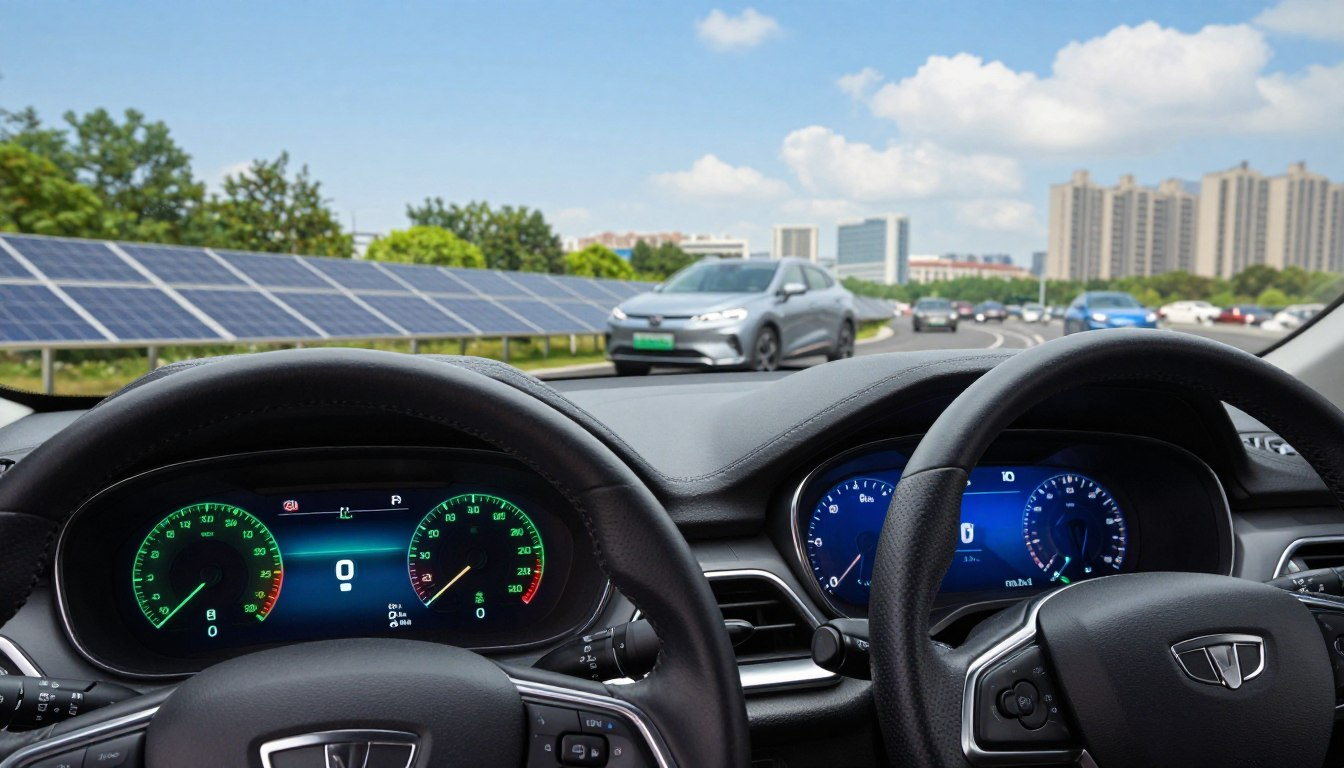
Eco mode vs normal mode isn’t a “good driver vs bad driver” choice. It’s a trade: your car offers efficiency by softening some responses—but whether that helps depends on where and how you drive.
Jane Goodall once warned that “the greatest danger to our future is apathy.” That line lands because the stakes aren’t always dramatic; they’re often ordinary. Your daily commute is one of those ordinary places where small choices stack up.
This guide shows you what Eco mode really changes, when it actually saves fuel, when Normal is the smarter choice, and—most important—how to prove the difference on your own routes so you’re not guessing.
The Two-Minute Answer
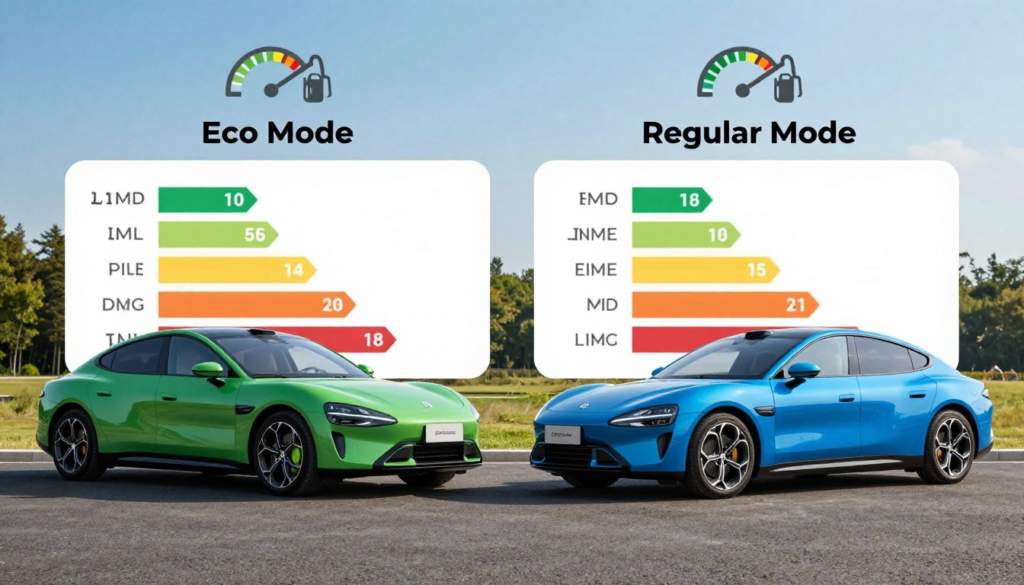
Use Eco mode when:
- You’re in stop-and-go traffic and want smoother starts and fewer throttle spikes.
- You’re doing steady-speed cruising on mostly flat roads.
- You drive a hybrid or EV and want gentler inputs that help regen and reduce unnecessary HVAC load.
Use Normal mode when:
- You need quick response for merging, overtaking, or short on-ramps.
- You’re driving hills/mountains where Eco causes “gear hunting” or sluggishness.
- You’re towing, heavily loaded, or in conditions where predictability and traction matter more than tiny efficiency gains.
If you want a one-page decision tool, use the printable scorecard:
Eco vs Normal Mode Scorecard (PDF)
Quick Safety Disclaimer
This article is general information and doesn’t replace your owner’s manual, local laws, or professional advice. Always drive safely, keep a safe following distance, and don’t attempt risky manoeuvres to save fuel. If Eco mode makes merging or control harder, switch back to Normal.
Why Most Get This Wrong
Most “Eco vs Normal” posts stop at: Eco saves fuel by reducing throttle response.
That’s incomplete.
Two drivers can press the same “ECO” button and see different results because:
- Eco mode is not identical across brands (some change HVAC, some don’t).
- Your route determines the outcome (hills vs flat, city vs motorway).
- Your biggest fuel losses might not be mode-related (roof drag, tyre pressure, speed creep).
The U.S. EPA/DOE fuel economy guidance even lists “Use the economy mode feature if your vehicle has one”—but it’s positioned among other high-impact behaviors like avoiding aggressive driving, keeping tyres properly inflated, and avoiding roof cargo. That’s the real clue: Eco mode helps most when the rest isn’t sabotaging it.
What Eco Mode Actually Changes (The “System Map”)
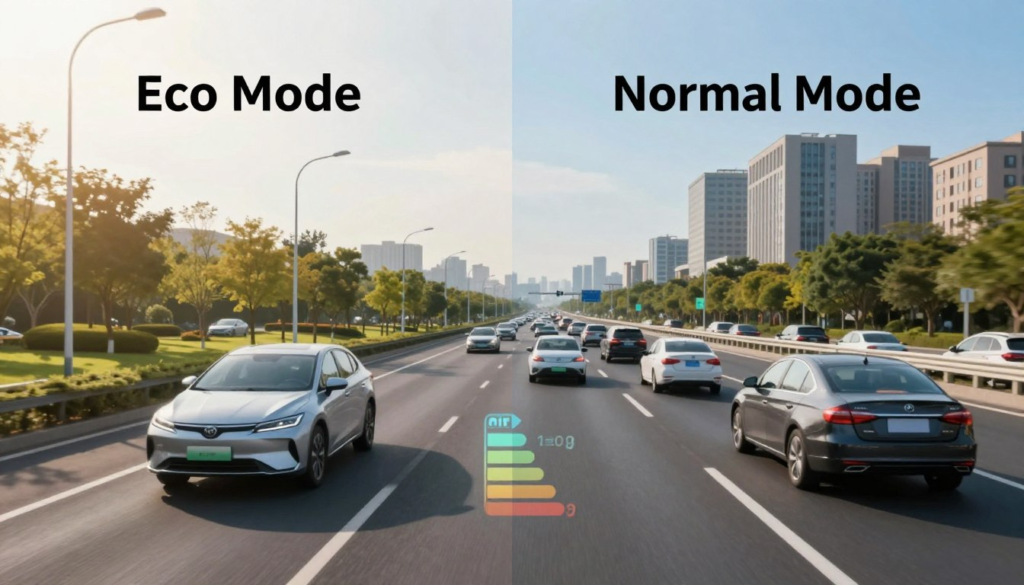
Think of Eco mode as a set of small system edits. Not all cars do all of them, but these are the common ones.
1) Throttle mapping (pedal feels “less eager”)
Eco mode often re-maps the pedal, so the same foot movement requests less torque. That reduces fuel-hungry surges.
2) Transmission strategy (autos/CVTs shift earlier)
Many vehicles shift earlier and try to hold higher gears longer to keep RPM lower—good for gentle driving, sometimes annoying on hills.
3) HVAC/accessory strategy (quiet MPG killer)
Some Eco modes reduce A/C compressor load or adjust climate behavior. Toyota’s Eco mode description is explicit that it can adjust throttle response and run air conditioning with reduced power (model-dependent).
4) Engine + transmission “efficiency points”
Nissan’s owner guidance describes Eco mode as adjusting engine and transmission control to help improve fuel economy.
5) Start/stop and regen “encouragement”
On hybrids especially, Eco mode can nudge smoother braking/acceleration patterns that help regenerative braking do more of the work.
Important: If your Eco mode only changes throttle feel, it may save less than an Eco mode that also manages HVAC and shift logic.
How to test Eco vs Normal on your route
If you don’t measure, you end up with vibes:
- “Eco felt slow, so it must be worse.”
- “Eco felt smooth, so it must be better.”
The 20–30 mile A/B test (simple, repeatable)
Pick one route you drive often (ideally 10–15 miles each way).
Keep these consistent:
- same time of day (traffic)
- similar weather (wind matters)
- similar HVAC use (defrost can dominate)
Run the route twice:
- once in Eco
- once in Normal
Record:
- average speed
- trip MPG (or L/100 km / kWh/mi)
- notes (traffic, wind, HVAC)
Tiny example (label it clearly as an example):
| Scenario | Distance | Fuel used | Result |
|---|---|---|---|
| Baseline week (Normal) | 210 miles | 8.4 gal | 25.0 MPG |
| After (Eco on best segments) | 210 miles | 7.8 gal | 26.9 MPG |
That “small” change is meaningful over a year.
Printable tool: Eco vs Normal Mode Scorecard (PDF)
Where Eco Mode Usually Wins (And Why)
1) Stop-and-go traffic
Eco mode can cut waste from repeated surges—especially if your car also uses start/stop effectively. The EPA/DOE guide notes start-stop systems can improve fuel economy by about 4–5% and provide the biggest benefit in stop-and-go driving.
Practical tip to add :
If Eco mode feels sluggish leaving lights, don’t mash the pedal (that cancels the point). Instead:
- build a larger gap
- accelerate smoothly
- let the transmission settle into higher gears
2) Flat motorway cruising
If you can hold a steady speed, Eco mode can help keep throttle inputs smooth. The same EPA/DOE guide notes cruise control often saves gas by helping maintain constant speed (conditions vary).
When Eco fails here: rolling hills + cruise control surging = the car may add throttle aggressively to maintain speed, which can wipe out gains.
3) Hybrids and EVs (often a bigger difference)
The EPA/DOE guide specifically recommends using Eco mode on many hybrids/EVs and reminds drivers that accessories like heating/AC can reduce range more for EVs and hybrids than conventional cars.
High-value angle:
For EVs, Eco mode can matter less through the drivetrain and more through HVAC behavior—because cabin heat is “paid” from the battery.
Where Normal Mode Is the Smarter Choice
1) Short on-ramps, frequent overtakes, high-speed merges
Eco mode’s softened throttle can create hesitation at the exact moment you want predictability.
Rule worth publishing:
If you need to accelerate right now for safety, switch to Normal.
2) Hills and mountains
Eco mode can cause:
- “gear hunting” (repeated shifting)
- delayed downshifts
- inconsistent engine braking
Normal mode often feels calmer and more controlled in variable grades.
3) Heavy loads or towing
Eco mode may try too hard to stay in higher gears. Under load, that can increase shifting or make the engine lug. Normal mode is usually better for drivability and control.
4) Severe weather (snow/ice) when you need precise control
Eco mode sometimes dulls response. In slick conditions, predictability matters more than small savings.
The Real Fuel Economy Difference:
Instead of promising “Eco mode saves X%,” a strong article explains the drivers of variation.
Variation driver #1: Speed
The EPA/DOE guide warns that aggressive driving can lower gas mileage roughly 15–30% at highway speeds and 10–40% in stop-and-go traffic. That’s larger than what Eco mode usually changes on its own.
Translation: If you drive 75–80 and brake late, Eco mode can’t “out-button” that.
Variation driver #2: HVAC (especially defrost)
Eco mode sometimes reduces HVAC demand; in winter, defrost can override everything. If visibility is at stake, comfort and safety win.
Variation driver #3: Drag and rolling resistance (roof racks + tyres)
The EPA/DOE guide reports a large rooftop cargo box can reduce fuel economy by 6–17% on the highway and even more at higher interstate speeds.
It also notes properly inflated tyres can improve fuel economy by about 0.6% on average.
High-value takeaway:
Eco mode gains get erased fast by roof drag and low tyre pressure.
A Simple Decision Matrix
| Driving situation | Better choice | Why |
|---|---|---|
| Stop-and-go city | Eco | Smooths throttle + supports start/stop behavior |
| Flat steady motorway | Eco | Helps keep inputs gentle and consistent |
| Rolling hills | Normal | Prevents surging/gear hunting |
| Short merges / overtakes | Normal | Faster response when it matters |
| Towing / heavy load | Normal | Better drivability and control |
| Winter defrost heavy | Normal | HVAC demand dominates; visibility first |
| Hybrid city driving | Eco | Encourages regen-friendly smoothness |
| EV cold weather range | Eco | Often reduces HVAC load and softens response |
The Trade-Off You Should Say Out Loud
Eco mode is not “free fuel.” It usually buys efficiency by:
- making it harder to over-accelerate
- keeping RPM lower
- reducing accessory power demand (sometimes)
Normal mode buys:
- response
- smoother control in complex conditions
- less “why won’t it downshift?” frustration
A strong article doesn’t shame either choice. It helps readers pick the right tool for the right segment.
“Beyond the Modes”: Three Upgrades That Often Beat Eco Mode
These are worth including because they’re supported by credible guidance and they keep your post from feeling thin or button-focused.
1) Fix the big behavior losses first
Aggressive driving penalties are huge.
If someone wants better economy, the biggest win is often smoother inputs—not a mode button.
2) Remove roof drag if it’s not needed
Roof cargo can cut fuel economy dramatically at speed.
This is one of the highest “£0 fixes.”
3) Keep tyres at door-sticker pressure
Tyre pressure affects rolling resistance and safety.
It’s a tiny habit with reliable upside.
Eco Mode Myths
Myth: Eco mode damages the engine.
Eco mode generally changes control strategy (throttle mapping/shift logic/HVAC load). It’s not an “engine strain” button.
Myth: Eco mode always saves fuel.
In hilly terrain, heavy loads, or constant overtakes, it may not help and can be annoying.
Myth: Eco mode is the only way to improve MPG.
The EPA/DOE guide highlights multiple factors—driving style, speed, idling, tyre pressure, roof cargo—often larger than mode differences.
Watch this before you go:
Eco mode helps save fuel by changing how your car works. It’s great for daily drives and long trips. This mode makes your car use less gas.
Conclusion: Use Eco Mode Like a Tool, Not a Personality
Eco mode vs normal mode is best treated like a route decision, not a belief system.
- Use Eco where driving is steady and predictable (traffic, cruising, hybrids/EVs).
- Use Normal when response and control matter (merging, hills, towing, tough weather).
- If you want a confident answer, do the simple A/B test and keep your notes.
And if you only do one “free” upgrade: remove roof drag and check tyre pressure. Those two erase more MPG than most people realize.
FAQs
1) Does Eco mode always improve fuel economy?
No. It often helps in stop-and-go or steady cruising, but may not help on hills, heavy loads, or frequent overtakes.
2) What does Eco mode change in most cars?
Common changes include throttle mapping, shift strategy, and sometimes HVAC/accessory power behavior (varies by brand/model).
3) Why does Eco mode feel slower?
Because throttle mapping is often softened—your pedal asks for power more gradually.
4) Is Normal mode “worse” for the environment?
Not automatically. Driving behavior (speeding, hard braking) can have a larger effect than mode choice.
5) When should I avoid Eco mode?
When you need quick response for merging/overtaking, when Eco causes gear hunting on hills, or when driving conditions demand precise control.
6) Do hybrids and EVs benefit more from Eco mode?
Often yes, because efficient acceleration and HVAC management can have a bigger effect on range and consumption.
7) Can Eco mode change air conditioning performance?
On some vehicles, yes—Eco may reduce A/C power or alter HVAC behavior to save energy.
8) What’s the best way to know if Eco mode helps me?
Run a simple A/B test on the same route (Eco vs Normal) and compare trip economy with similar traffic/HVAC conditions.
Sources
Time (Jane Goodall quote):
https://content.time.com/time/magazine/article/0,9171,1003125,00.html

EPA / DOE Fuel Economy Guide (fuel-saving tips, aggressive driving %, roof cargo %, tire pressure, economy mode):
https://woodridgememoriallibrary.org/newsite/wp-content/uploads/FEG2019.pdf

Nissan owner information (Eco mode description varies by model):
https://www.nissan-techinfo.com/refgh0v/og/sentra/2018/2018-sentra.pdf  (see ECO mode section)

Toyota (Eco mode affects throttle + A/C on some models):
https://www.toyota.co.uk/new-cars/yaris/gr-sport/features